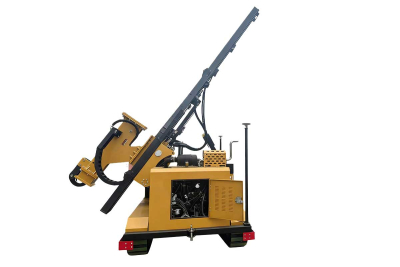
Crawler open pit down the hole drilling rig
A high‑efficiency deep‑hole DTH (Down‑The‑Hole) drill rig capable of reaching a maximum drilling depth of 2,500 meters relies on the coordinated operation of a complete DTH drilling system. Puhua Energy Equipment Technology (Shandong) Co., Ltd. has engineered such a system, which consists of two major parts: the air compression system and the drill rig execution system. Working together, they deliver reliable deep‑hole drilling performance for mining, engineering, and other complex applications.

1. Air Compression System – The Power Source
The air compression system provides the core power for the entire DTH drill rig. Its heart is an air compressor specially matched to the deep‑hole DTH rig, driven by a 500 HP heavy‑duty engine – meeting the power demand for 2,500 m deep drilling.
The engine shaft is directly connected to the compressor. When started, it rotates a pair of intermeshing male and female rotors at high speed inside the compressor. To ensure air cleanliness and prevent impurities from wearing internal parts, an air filter is mounted on top of the compressor. Outside air passes through this filter to remove dust and debris before entering the compressor.
As the rotors turn, the incoming air is compressed into high‑temperature, high‑pressure gas. To protect downstream pipes and equipment, a high‑power radiator is installed on the side of the compressor to cool the hot compressed air. The cooled high‑pressure air is then sent through pipes to the drill control panel, where the pressure is precisely regulated. From there, it is distributed via three pipes to the top of the drill rig:
The largest pipe connects to the main spindle of the drill rig.
The two smaller pipes connect to two pneumatic motors, providing stable power for spindle rotation and impact action.
2. Rotary Power – Pneumatic Motor with Eccentric Shaft
Looking inside the DTH rig’s pneumatic motor, you will find an eccentric shaft design. This eccentricity improves power transmission efficiency and meets the high‑strength demands of deep‑hole drilling.
When high‑pressure air enters the pneumatic motor, the air pressure pushes the motor’s vanes, causing the motor to rotate. The rotating motor then drives the main spindle of the DTH rig through a gear transmission, providing stable rotary power for deep‑hole drilling. This ensures both drilling accuracy and efficiency.

3. Impact Mechanism – The Core for Efficient Rock Breaking
The ability of a DTH drill rig to deliver high‑efficiency impact drilling and rapid rock breaking lies in its impact mechanism – the very core that determines drilling depth and efficiency. This mechanism consists of three main parts:
Main drill bit at the bottom end
Hollow piston connected behind the main bit
Hollow cylinder surrounding the piston
The hollow cylinder has rows of circular holes at both ends. Most of the piston length lies inside the hollow cylinder. A pilot valve precisely controls the reciprocating impact motion of the piston, ensuring consistent and stable impact action.
3.1 Detailed Working Cycle of the Impact Mechanism
Step 1 – Air enters the cylinder
High‑pressure air flows through pipes into the hollow cylinder. The pilot valve moves downward, guiding air to flow out of the cylinder’s circular holes and down along the pipe wall.
Step 2 – Air is trapped
When the air reaches a specific position, it enters the annular gap between the hollow cylinder and the piston through another set of circular holes. At this point, the air passage is completely blocked. The air that cannot escape can only rise slowly through the tiny gap between the cylinder and piston, eventually filling a particular chamber.

Step 3 – Downward impact
When this chamber is fully filled with compressed air, the air pressure exerts a strong squeezing force on the piston, creating a huge downward force. This force drives the piston to strike the main drill bit violently – breaking rock and enabling deep‑hole drilling.
Step 4 – Air discharge and chip removal
During the piston’s downward movement, the passage that was previously blocked by the piston (where the hollow cylinder separates from the piston) opens immediately. The high‑pressure air in the chamber then flows rapidly downward through internal passages in the piston and finally exits through the gaps at the bottom of the drill bit. This airflow also carries away rock cuttings (chips) generated during drilling, preventing accumulation that would slow down progress.
Step 5 – Return stroke
After the air is discharged, the pressure above the piston drops instantly. Meanwhile, remaining high‑pressure air quickly fills another chamber below the piston, causing the pressure there to rise sharply. This increased pressure pushes the piston back upward to its initial position.
Step 6 – Pressure relief
As the piston rises, its connection with the pipe separates again, allowing the air in the chamber to flow downward through the pipe and be discharged – completing the pressure relief.
Step 7 – Cycle repeats
One full impact cycle ends. This cycle repeats at a very high frequency, continuously driving the DTH drill bit downward, impacting and breaking rock. Through this efficient process, the DTH drill rig achieves a maximum drilling depth of 2,500 meters, meeting the deep‑hole drilling demands of mining, construction, and other engineering projects.

Conclusion
The deep‑hole DTH drill rig from Puhua Energy Equipment Technology (Shandong) Co., Ltd. integrates a powerful air compression system, an efficient pneumatic rotary motor, and a high‑frequency impact mechanism. This coordinated system enables reliable, productive drilling down to 2,500 m – making it an ideal choice for demanding drilling operations worldwide.
Frequently Asked Questions (FAQ)
Q1: What is the maximum drilling depth of this DTH drill rig?
A: The system is designed to reach a maximum depth of 2,500 meters under suitable geological conditions.
Q2: What power source does the air compressor use?
A: The compressor is driven by a 500 HP heavy‑duty engine (diesel or electric options available upon request). Direct shaft coupling ensures efficient power transmission.
Q3: How does the impact mechanism avoid overheating during long operations?
A: The compressed air is cooled by a high‑power radiator before entering the drill. Moreover, the exhaust air from the impact cycle continuously flows through the bit, providing natural cooling and chip removal.
Q4: What types of rock can this DTH rig handle?
A: It is suitable for medium‑hard to very hard rock (e.g., granite, basalt, limestone, iron ore) with compressive strengths commonly encountered in deep mining and engineering drilling.
Q5: Is the pneumatic motor maintenance‑friendly?
A: Yes. The eccentric shaft design is robust and simple. Regular lubrication and air filter cleaning are the main maintenance tasks. All wearing parts are accessible for replacement.
Q6: Can the system be customised for different drilling diameters?
A: Absolutely. Puhua offers various DTH hammer and bit sizes to match different diameter requirements, from standard blast holes to large‑diameter engineering holes.
Q7: What after‑sales support does Puhua provide?
A: We supply spare parts, remote technical guidance, and on‑site commissioning services. Our team can also provide operator training to ensure optimal performance.