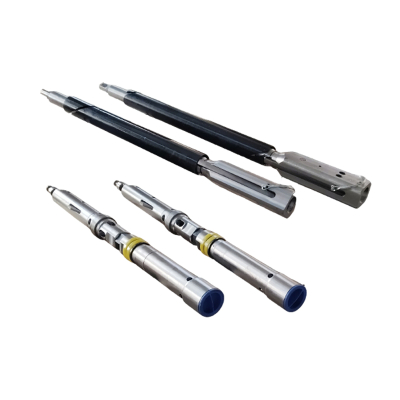
Main Components of Rotary Drilling Rig
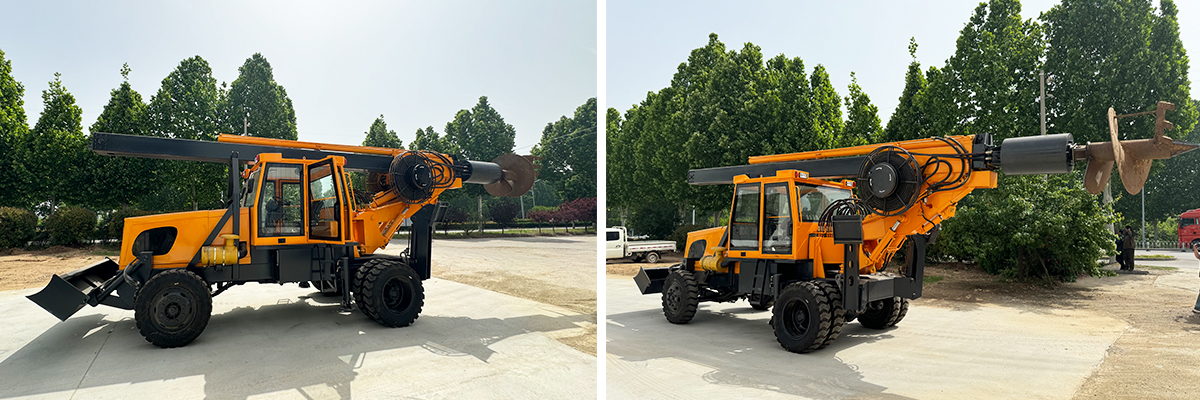
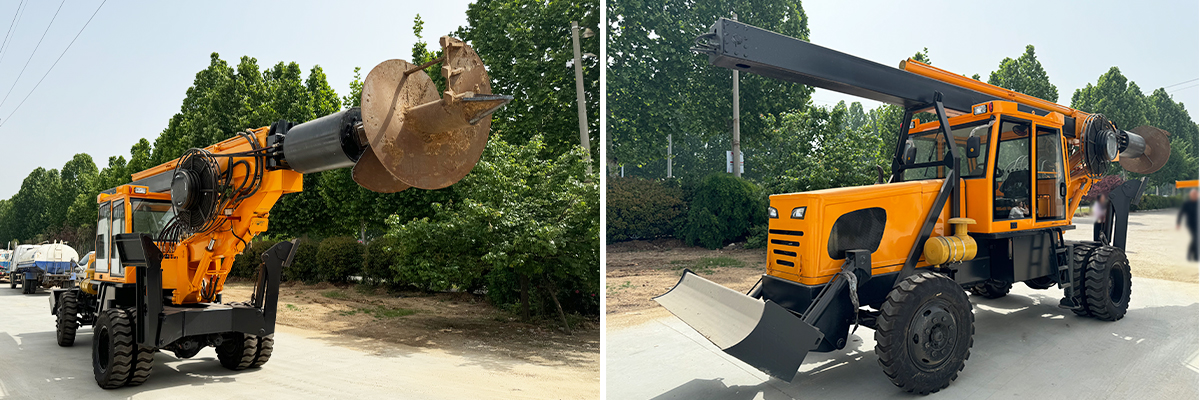
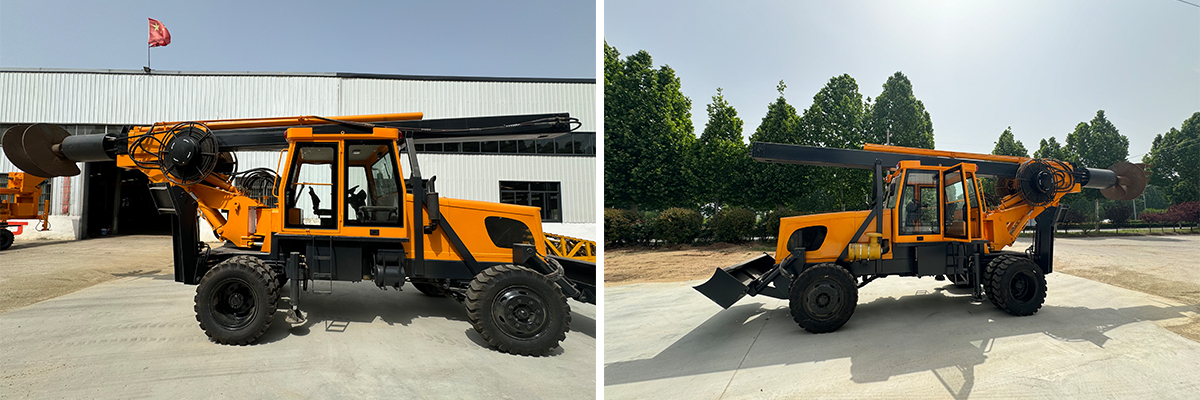
Rotary drilling rig is a key construction equipment widely used in foundation engineering such as pile driving, bridge construction, and high-rise building foundation. Its stable and efficient operation relies on the close cooperation of various core components. Below is a detailed introduction to the main components of rotary drilling rig, helping foreign trade customers better understand the product performance and structural characteristics.
1. Drill Pipe & Drilling Tools
As the core transmission component of rotary drilling rig, drill pipe is divided into internal friction type external pressure telescopic drill pipe and automatic internal locking interlocking type external pressure telescopic drill pipe. The internal friction type drill pipe has high drilling efficiency in soft soil layers, while the locking type drill pipe enhances the downward pressure exerted by the power head on the drill pipe and transmits it to the drilling tools, which is suitable for drilling in hard rock formations and requires higher operation skills. To improve construction efficiency, most drilling rigs are equipped with two sets of drill pipes.
There are various types of rotary drilling rig drill bits, including long auger and large-diameter short auger bits, rotary drilling buckets, sand fishing buckets, cylindrical drilling buckets, underreaming bits, core bits, etc. Different drill bits are selected according to different stratum conditions, which is an important guarantee for improving drilling efficiency and quality. Keywords: rotary drilling rig drill pipe, rotary drilling bit, telescopic drill pipe, hard rock drilling bit.
2. Power Head
The power head is a vital power output component of the rotary drilling rig, whose main function is to output torque to drive the drill pipe and drill bit to rotate. It is composed of a variable hydraulic motor, planetary reducer, power box and some auxiliary components. Working principle: The high-pressure oil delivered by the hydraulic pump drives the hydraulic motor to output torque, and the torque is reduced and increased through the planetary reducer and power box.
The power head has three transmission modes: hydraulic transmission, motor transmission and engine transmission. No matter which mode is adopted, it has the functions of low-speed drilling and reverse high-speed soil throwing. At present, most rotary drilling rigs adopt hydraulic drive, which is divided into double variable hydraulic motor, double-speed reducer drive or low-speed and high-torque hydraulic motor drive. The drilling speed of the power head is usually multi-gear, which is suitable for operation under various working conditions. Keywords: rotary drilling rig power head, hydraulic drive power head, low-speed high-torque power head.
3. Winch
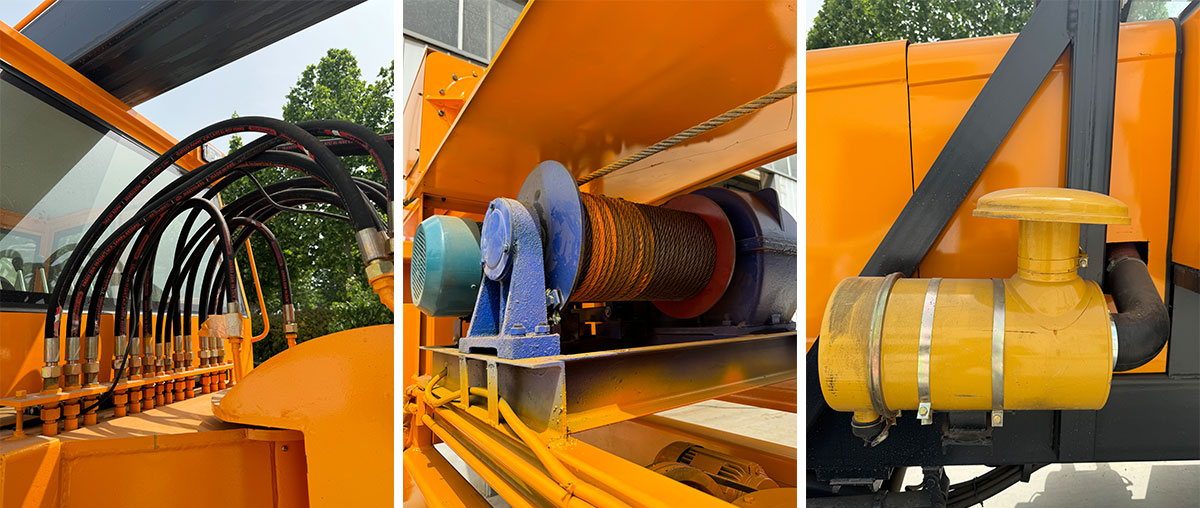
The winch is an important lifting component of the rotary drilling rig, including main winch and auxiliary winch. The main winch is used to lift and lower the drill pipe, while the auxiliary winch is used for auxiliary operations such as hoisting accessories. During operation, the main valve provides hydraulic oil for the winch hydraulic motor, and the commutation of the main valve realizes the left and right rotation of the winch hydraulic motor, thereby driving the drill pipe and drilling tools to rise and fall.
The main winch is a key component affecting drilling efficiency, drilling accident rate and steel wire rope service life. It is composed of hydraulic motor, planetary reducer, brake, drum and steel wire rope. Working principle: The high-pressure oil output by the hydraulic pump drives the main winch motor, and at the same time opens the oil circuit and mechanical brake. The torque is reduced and increased through the reducer, and the drum is driven to rotate to lift or lower the main winch.
The Italian IMT rotary drilling rig is equipped with drill pipe ground contact protection to prevent steel wire rope damage caused by messy ropes. Especially the rotary drilling rig produced by Italy IMT Company has a large drum capacity for the main winch, and the steel wire rope is arranged in a single-layer winding, which ensures constant lifting force and avoids overlapping and rolling of the steel wire rope, thus reducing wear between steel wire ropes and prolonging the service life of the steel wire rope. The main winches of foreign rotary drilling rigs all adopt flexible non-rotating steel wire ropes to further improve service life. Keywords: rotary drilling rig winch, main winch, auxiliary winch, non-rotating steel wire rope.
4. Pressurizing Device
The main function of the pressurizing device is to apply pressure to the power head. The pressure is transmitted through the pressurizing device → power head → drill pipe → drill bit → tooth tip to realize cutting, crushing or grinding of the stratum. There are two types of pressurizing methods: oil cylinder pressurization and winch pressurization.
Oil cylinder pressurization: The pressurizing oil cylinder is fixed on the mast, and the piston of the pressurizing oil cylinder is connected to the power head sliding frame. Working principle: The auxiliary hydraulic pump of the drilling rig provides high-pressure oil, which enters the rodless cavity of the oil cylinder to push the piston of the oil cylinder to move, applying pressure to the power head. When stopping, the one-way balance valve locks the oil to prevent the power head from sliding down. Advantage: simple structure and convenient maintenance.
Winch pressurization: A winch assembly is installed on the mast, and two steel wire ropes are wound oppositely on the drum, one for pressurization and the other for lifting. It is connected to the power head movable pulley through the fixed pulley on the mast, and then fixed on the lower mast and upper mast respectively to realize lifting or pressurizing working conditions. Advantage: larger pressurizing force can be achieved through the movable pulley, and the long auger construction method can be realized. Disadvantage: the structure is relatively complex, assembly and disassembly are troublesome, and more precautions are needed during operation. Both oil cylinder pressurization and winch pressurization realize the pressurizing working condition, only the pressurizing forms are different. Keywords: rotary drilling rig pressurizing device, oil cylinder pressurization, winch pressurization.
5. Chassis
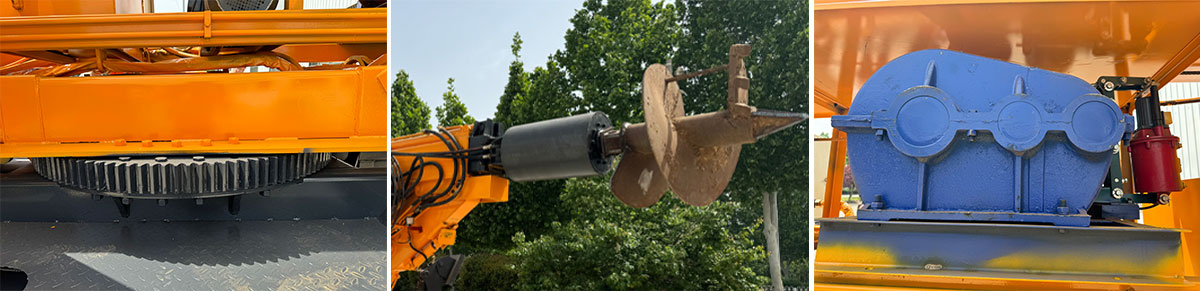
The chassis of the rotary drilling rig can be divided into special chassis, crawler hydraulic excavator chassis, crawler crane chassis, walking chassis, truck chassis, etc. Among them, the crawler special chassis has the advantages of compact structure, convenient transportation, beautiful appearance, but high cost. At present, most rotary drilling rigs produced at home and abroad adopt special chassis.
The main accessories of the rotary drilling rig chassis include four wheels and one track: the four wheels refer to the carrier roller, driving wheel, idler wheel and track roller; the one track refers to the crawler.
- Idler wheel: It is used to guide the crawler and is located at the end opposite to the driving force. Usually, each rotary drilling rig is equipped with 2 idler wheels.
- Track roller: It is used to support the crawler, and the quantity varies according to the tonnage of the rotary drilling rig. Usually, there are 1-2 track rollers on one side.
- Carrier roller: As the name implies, it plays a supporting role, located between the lower surface of the left/right beam of the underframe and the crawler. The quantity varies according to the tonnage of the drilling rig, usually 5-10 on one side.
- Driving wheel: It is used to drive the crawler, fixed on the travel motor, and transmits the driving force of the travel motor to the crawler through the gear structure. Usually, there is 1 driving wheel on each travel motor.
Other chassis parts of the rotary drilling rig include: idler wheel, track roller, carrier roller, driving gear, chain, chain link, chain pin, bucket shaft, four wheels and one track, track assembly, idler wheel bracket, slewing bearing, crawler, rubber crawler, track plate, tensioning device, tensioning cylinder seat, tensioning cylinder, universal cross. Keywords: rotary drilling rig chassis, crawler chassis, four wheels and one track, slewing bearing, track assembly.
In summary, each main component of the rotary drilling rig undertakes a unique function, and their coordinated operation ensures the stable, efficient and safe construction of the equipment. For foreign trade customers, understanding the performance and characteristics of each component is of great significance for selecting suitable equipment, daily maintenance and reducing failure rate.
FAQ
Q: Tips for selecting a drill pipe for different strata?
A: For soft soil (clay, silt), use an internally friction-type telescopic pipe with external pressurization. For hard rock (granite, basalt), use an automatic interlocking telescopic pipe with external pressurization. It is recommended to have two drill pipes per rig for flexible switching.
Q: What causes low torque from the rotary head?
A: Three common causes:
Low hydraulic pump output – check for blockages or leaks.
Worn planetary reducer – cannot increase torque effectively.
Auxiliary part failure (e.g., damaged seals, poor lubrication). Regularly inspect and lubricate.
Q: How to extend main winch wire rope life?
A: 1. Use a flexible non-rotating rope to avoid crushing.
2. Ensure single-layer winding on the drum to reduce friction.
3. Check rope tension regularly and use a ground-touch protection device to prevent tangling and impact damage.
Q: Cylinder vs. winch pressurization – how to choose?
A: For simple sites and easy maintenance, choose cylinder pressurization (simple, low cost, suitable for soft/medium strata). For greater force or long screw method, choose winch pressurization (complex assembly, watch for rope tangling).
Q: How to maintain the "four wheels and one track"?
A: 1. Remove mud and gravel regularly.
2. Check and refill wheel lubricant.
3. Avoid prolonged work on hard/sharp ground.
4. Adjust track tension with the tensioning device.
Q: Which drill bit for which application?
A: Long/short screw bits – soft soil & sand layers. Rotary bucket / sand bailer – sand & gravel layers. Core barrel – rock & hard soil. Under-reaming bit – enlarge pile bottom for higher bearing capacity. Core bit – geological sampling.