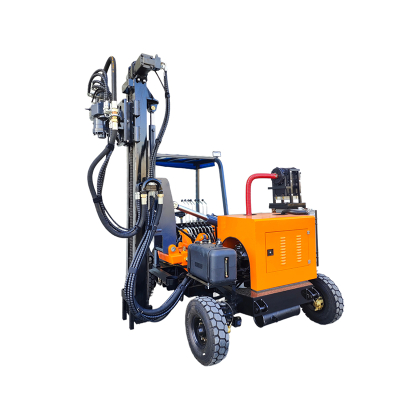
What is the Best Tunnel Drilling Rig for Small-Diameter Drainage Tunnels?
Selecting the right equipment for small-diameter drainage tunnels presents a unique set of engineering challenges. Unlike large-scale infrastructure projects such as highway or railway tunnels, drainage tunnels often operate within confined spaces, require high maneuverability, and demand precision to avoid over-excavation in sensitive geological conditions. For contractors and project managers, identifying the optimal tunnel drilling rig is not merely a purchasing decision—it is a strategic investment in project efficiency, safety, and long-term operational cost control.
In this article, we explore the critical factors defining the ideal tunnel drilling rig for small-diameter applications, analyze key technical specifications, and provide guidance on selecting a machine that balances power with compact design.

Defining the Challenge of Small-Diameter Drainage Tunnels
Small-diameter drainage tunnels typically range from 1.5 to 3.5 meters in finished internal diameter. These projects are commonly found in urban stormwater management systems, hydroelectric power plant tailrace tunnels, and mining dewatering operations. The primary constraints in such environments include:
Restricted Cross-Sections: Limited space prohibits the use of large, multi-boom jumbos designed for highway tunnels.
Complex Alignment: Drainage tunnels often follow curved or sloping alignments to facilitate gravity flow, requiring a drilling rig with exceptional articulation.
Geotechnical Sensitivity: Many drainage tunnels are excavated in variable ground conditions, from soft ground to fractured hard rock, demanding a versatile tunnel drilling rig capable of adapting its drilling method.
Given these constraints, the “best” rig is not necessarily the largest or most powerful, but rather the one offering the optimal combination of compact dimensions, drilling accuracy, and operational flexibility.

Key Specifications to Evaluate in a Tunnel Drilling Rig for Small Diameters
When sourcing a tunnel drilling rig for small-diameter drainage projects, buyers should prioritize the following technical parameters.
1. Overall Dimensions and Weight
The rig’s width, height, and transport length directly determine its accessibility. For tunnels with a finished diameter under 3.5 meters, the tunnel drilling rig should ideally have a stowed width not exceeding 1.6 meters to navigate through narrow access adits. Additionally, lightweight designs—typically under 12 tons—facilitate easier relocation between work faces and reduce logistical costs.
2. Boom Articulation and Coverage
A single-boom or split-boom configuration is generally preferred over multi-boom units for small-diameter tunnels. The boom must offer:
360-degree roll rotation for precise hole positioning around the tunnel perimeter.
Extended reach to cover the entire face and sidewalls without repositioning the carrier excessively.
Low-profile articulation that allows drilling close to the tunnel invert and crown.
3. Drilling Power and Rod Length
While compactness is essential, the rig must not compromise on penetration rate. A high-performance tunnel drilling rig for drainage applications should feature a rock drill with impact power ranging from 15 kW to 25 kW, capable of handling hole diameters between 45 mm and 89 mm for bolt holes or probe drilling. A rod length of 3.0 to 3.7 meters is standard to balance productivity with the limited feed length available in small cross-sections.
4. Automation and Safety Features
Modern drilling rigs increasingly incorporate semi-automated drilling cycles, telematics for remote diagnostics, and ergonomic operator cabins. For drainage tunnel work, where confined spaces increase safety risks, features such as anti-jamming systems, automatic rod handling, and remote control operation significantly reduce exposure to hazardous zones.

Comparing Rig Types: Wheeled vs. Tracked Carriers
Two primary carrier configurations dominate the small-diameter tunnel drilling rig market.
| Carrier Type | Advantages | Limitations |
| Tracked Carrier | Superior traction in wet or uneven invert conditions; lower ground pressure; ideal for unlined drainage tunnels. | Slower travel speed between faces; requires low-loader transport for longer moves. |
| Wheeled Carrier | Faster mobility; better suited for projects with multiple access points; often more compact turning radius. | Reduced traction in extremely muddy conditions; higher ground pressure may damage unconsolidated invert. |
For most small-diameter drainage tunnels—particularly those with standing water or soft invert—a rubber-tracked tunnel drilling rig offers the best balance of stability, traction, and low ground pressure.
Why Customization Matters in Small-Diameter Drilling
Off-the-shelf drilling rigs rarely fit perfectly into highly constrained drainage tunnel profiles. Reputable manufacturers offer tailored solutions such as:
Narrowed chassis to meet specific tunnel cross-sections.
Custom feed lengths to maximize hole depth while accommodating limited face clearance.
Integrated dust collection systems to maintain air quality in confined headings.
When evaluating suppliers, buyers should prioritize those with demonstrated engineering capability to modify their tunnel drilling rig to site-specific requirements rather than forcing a standard machine into an unsuitable application.

Frequently Asked Questions (FAQ)
Q1: Can a standard tunnel drilling rig used for highway tunnels work in a 2.5-meter drainage tunnel?
A: In most cases, no. Standard multi-boom rigs designed for highway tunnels typically exceed 2.2 meters in width and lack the necessary maneuverability for tight curves and low overhead clearance. A specialized tunnel drilling rig for small-diameter drainage tunnels is engineered with a reduced footprint, single-boom articulation, and optimized weight distribution to operate safely and efficiently in confined spaces.
Q2: What is the typical penetration rate for a compact tunnel drilling rig in hard rock?
A: Penetration rates vary by rock type and rock drill specifications. A high-quality compact tunnel drilling rig equipped with a 20–25 kW hydraulic rock drill can achieve penetration rates of 1.5 to 2.5 meters per minute in medium-hard granite (UCS 150–200 MPa) using 45 mm drill bits. For softer sedimentary rock, rates can exceed 3.0 meters per minute, significantly accelerating cycle times.
Q3: How important is automation for small-diameter drainage tunnel projects?
A: Automation is increasingly critical, even in small tunnels. Features such as auto-drill cycles, collaring assistance, and drill plan storage reduce operator fatigue and minimize overbreak—a common challenge in small-diameter tunnels where over-excavation represents a high percentage of wasted material. Additionally, remote control operation allows the operator to stand clear of the face, improving safety during scaling and drilling.
Q4: What after-sales support should I expect from a tunnel drilling rig manufacturer?
A: For B2B buyers, after-sales support is as important as the equipment itself. A reliable manufacturer should offer:
A documented spare parts availability guarantee with local warehousing in key markets.
On-site commissioning and operator training programs.
24/7 technical support and remote diagnostics via telematics.
A warranty structure that covers structural components for a minimum of 12 months or 2,000 operating hours.
Selecting the best tunnel drilling rig for small-diameter drainage tunnels requires a disciplined focus on application-specific engineering. The ideal machine combines a compact, maneuverable carrier with a high-performance rock drill, precise boom articulation, and advanced safety features—all backed by robust after-sales support.
By prioritizing these criteria, contractors can not only accelerate advance rates but also reduce operational risks and total cost of ownership. As global infrastructure investment increasingly targets urban drainage renewal and hydropower expansion, the demand for specialized, high-efficiency tunnel drilling rigs continues to grow. Investing in the right equipment today ensures competitive positioning for the complex underground projects of tomorrow.
Need assistance selecting the right tunnel drilling rig for your drainage project? Contact our engineering team for a tailored equipment assessment and site-specific recommendations.