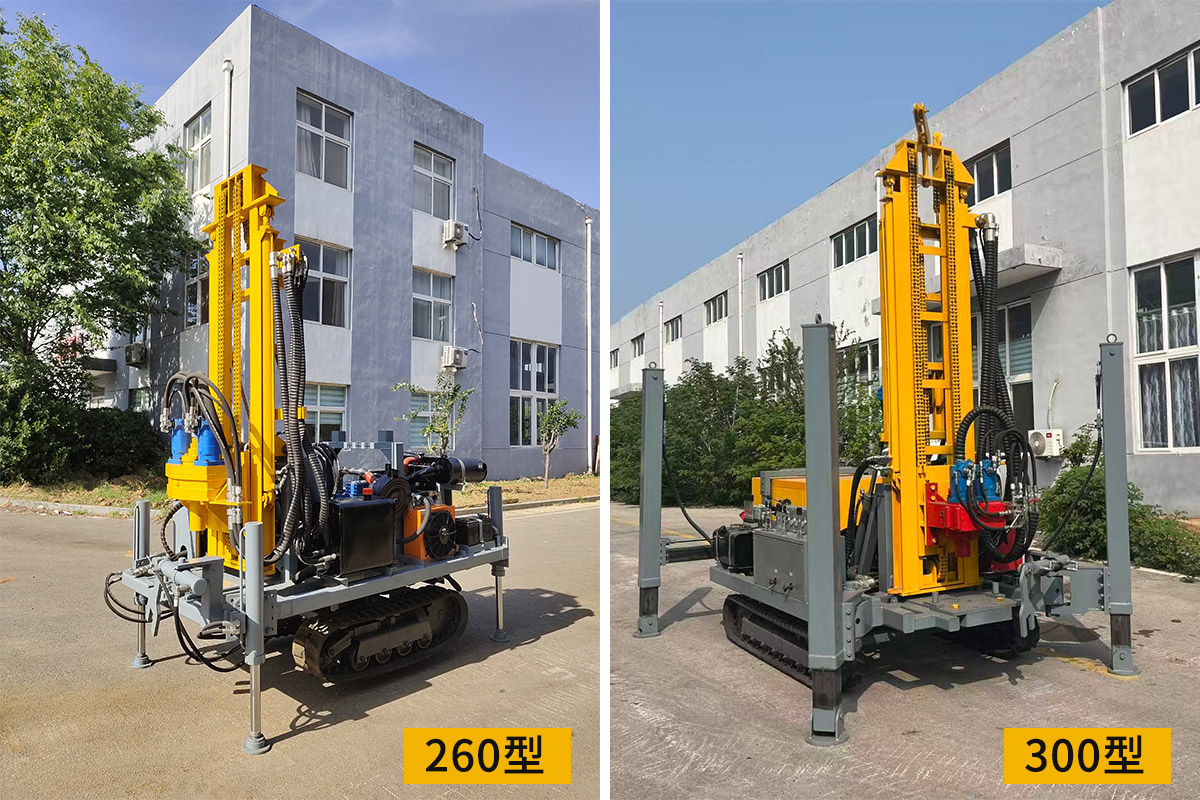
260m vs. 300m Water Well Drilling Rig
Choosing the right water well drilling rig is an important decision for drilling contractors, agricultural businesses, and engineering companies. When comparing a 260m water well drilling rig with a 300m water well drilling rig, buyers should look beyond the rated drilling depth. Geological conditions, borehole diameter, drilling methods, equipment configuration, and long-term operating costs all influence the final choice.
A rig designed for a 260-meter drilling depth may be suitable for many groundwater projects, while a 300-meter water well drilling rig can provide additional depth capacity for projects that require deeper boreholes. However, a higher rated depth does not automatically mean better performance for every application.
Understanding the differences between these two equipment categories can help buyers select a practical solution for their projects and investment budgets.
1. Understanding the Difference Between 260m and 300m Water Well Drilling Rigs
The primary difference between a 260m water well drilling rig and a 300m water well drilling rig is their rated drilling depth. The appropriate choice depends on the planned well depth and the actual drilling conditions.
260m Water Well Drilling Rig
A 260m water well drilling rig can be considered for projects where the planned borehole depth falls within its verified operating capabilities. Typical applications may include agricultural irrigation wells, farm water supply, rural water projects, and other groundwater development tasks.
For contractors working on projects with relatively consistent depth requirements, selecting equipment that matches the intended workload can help avoid unnecessary investment in capacity that may not be regularly used.
Before purchasing, buyers should verify whether the rig can achieve the required depth under the expected borehole diameter, geological conditions, and drilling method.
300m Water Well Drilling Rig
A 300m water well drilling rig may be a better option for projects that require deeper boreholes or greater flexibility in future project planning.
Additional rated depth can be useful when groundwater conditions vary between locations or when contractors expect to undertake projects with different depth requirements. However, actual drilling capability depends on the complete equipment configuration, including the available drilling torque, feed force, drill pipes, pump or compressor capacity, and other supporting components.
The rated depth should therefore be treated as one of several selection criteria rather than the sole indicator of performance.
2. Compare Your Project's Groundwater Requirements
Before comparing equipment prices, buyers should establish the actual requirements of their drilling projects.
Important questions include:
What is the planned depth of the well?
What borehole diameter is required?
Is the project located in soft soil, gravel, fractured rock, or hard rock?
Will the rig use mud rotary drilling, air drilling, or another suitable method?
Is the well intended for agricultural irrigation, industrial water supply, or rural water access?
Are there local regulations governing groundwater extraction and well construction?
These details help determine whether a 260m rig provides sufficient capacity or whether a 300m model is a more appropriate investment.
For example, a project with a planned depth of 200 meters may not require a 300m rig if the 260m equipment can reliably complete the work under the specified conditions. Conversely, a project approaching the practical operating limits of a 260m rig may justify considering a higher-capacity alternative.
The final decision should be based on the actual drilling plan rather than depth figures alone.
3. Consider Geological Conditions and Drilling Methods
Geology has a major influence on drilling performance. Two wells with the same target depth may require different equipment configurations because their geological formations are different.
Soft Soil and Unconsolidated Formations
Loose soil, sand, and gravel can create borehole stability challenges. Depending on the site, casing, drilling fluid, and appropriate circulation practices may be necessary.
In these conditions, buyers should consider the rig's compatibility with the selected drilling method and the supporting equipment required to maintain borehole stability.
Hard Rock and Fractured Rock
Hard rock formations may require different drilling tools and drilling methods from those used in unconsolidated soil. Air drilling with down-the-hole (DTH) equipment or other suitable techniques may be considered according to the formation and project requirements.
Drilling through hard rock can increase tool wear and affect penetration rates. A rig's rated depth alone does not establish whether it can efficiently drill through a particular rock formation.
Buyers should confirm that the rig, drill rods, drill bits, and associated power systems are suitable for the expected geology.
4. Evaluate Drilling Efficiency, Not Just Maximum Depth
Maximum drilling depth is an important specification, but it does not fully describe a machine's productivity.
When comparing a 260m water well drilling rig with a 300m model, consider the following factors:
Drilling torque and rotation speed: These affect how the rig works with different drilling tools and formations.
Feed force and lifting capacity: These influence the rig's ability to handle drill pipes and perform drilling operations safely within its specified operating limits.
Drill pipe configuration: Pipe length, diameter, strength, and compatibility can influence drilling operations and the achievable depth.
Mud pump or air compressor compatibility: The required supporting equipment depends on the drilling method, hole diameter, formation, and operating conditions.
Rig mobility and setup: Crawler-mounted and truck-mounted configurations may suit different terrain, transportation arrangements, and jobsite requirements.
Maintenance and serviceability: Accessible components, spare parts availability, and technical support can influence equipment uptime and operating expenses.
A properly configured 260m rig may be more productive and economical for a particular project than a larger rig that is not well matched to the application. Similarly, a suitable 300m rig may offer greater flexibility when deeper wells are a regular part of the contractor's workload.
5. Compare Total Ownership Costs
Purchase price is only one part of the investment. B2B buyers should evaluate the total cost of owning and operating the drilling equipment.
A practical cost assessment should include:
Initial equipment purchase price
Transportation and delivery expenses
Drill pipes, bits, and other consumables
Fuel or energy consumption
Routine maintenance and replacement part
Operator training and labor requirements
Supporting equipment, such as mud pumps or air compressors
Expected utilization across current and future projects
A 260m water well drilling rig may offer a cost-effective option when most projects fall comfortably within its verified operating range. A 300m rig may justify its higher purchase cost when the additional capacity is likely to be used frequently or when it helps a contractor undertake projects that would otherwise require different equipment.
Rather than choosing solely by the lowest price or highest depth rating, buyers should compare the expected cost per completed well and the equipment's suitability for their project pipeline.
6. Which Rig Is Better for Different Applications?
The following comparison provides a general guide. Final suitability depends on the manufacturer's verified specifications and actual site conditions.
Selection factor | 260m water well drilling rig | 300m water well drilling rig |
Planned drilling depth | Projects within its verified operating capability | Projects requiring greater rated depth |
Investment approach | May suit buyers seeking sufficient capacity for regular workloads | May suit buyers who need additional depth capacity |
Project flexibility | Suitable for projects matching its configuration | May provide greater flexibility for deeper projects |
Geological suitability | Depends on configuration, tools, and formation | Depends on configuration, tools, and formation |
Operating costs | Must be assessed for the intended workload | Must be assessed against the additional capacity and expected use |
For agricultural irrigation, rural water supply, and general groundwater projects, the right choice depends on the well design and local geology. For drilling contractors serving multiple customers, future project requirements should also be considered when evaluating equipment capacity.
7. What Should Buyers Confirm Before Placing an Order?
Before purchasing a 260m or 300m water well drilling rig, request a detailed specification sheet and confirm the following points with the manufacturer:
Rated drilling depth: Confirm the conditions under which the stated depth can be achieved.
Borehole diameter: Check the supported diameter range and how it affects drilling depth.
Drilling method: Confirm compatibility with the intended rotary, mud, or air drilling process.
Power system: Review the engine or motor configuration and the requirements of the complete drilling system.
Supporting equipment: Establish whether drill pipes, bits, pumps, compressors, and other accessories are included.
Transport and installation: Check machine dimensions, weight, transportation arrangements, and site access requirements.
After-sales support: Ask about spare parts, technical assistance, maintenance guidance, and warranty terms.
Project-specific suitability: Provide the supplier with the target depth, borehole diameter, geological information, and intended application.
These checks can reduce the risk of purchasing equipment that appears suitable on paper but does not meet the requirements of the actual project.
8. Choose the Right Water Well Drilling Rig for Your Business
The choice between a 260m water well drilling rig and a 300m water well drilling rig should be based on the required well depth, geological conditions, drilling method, operating costs, and future business plans.
A 260m rig may be the practical choice for projects within its verified capacity, while a 300m rig may be more suitable when deeper drilling capability is a recurring requirement. Neither option is universally better; the goal is to select equipment that can perform reliably under the conditions you expect to encounter.
Puhua Energy Equipment Technology (Shandong) Co., Ltd provides water well drilling equipment solutions for different project requirements. When evaluating a drilling rig, buyers should compare the available configurations against their intended applications rather than relying on rated depth alone.
Looking for a suitable water well drilling rig for your next project? Contact Puhua Energy Equipment Technology (Shandong) Co., Ltd with your target drilling depth, required borehole diameter, geological conditions, and application details. Our team can help you evaluate suitable equipment configurations and identify a solution that aligns with your operational needs and investment plans.